Category Archives: General

ClinCalc DrugStats: Most Commonly Prescribed Medications in 2024

ClinCalc has released the latest edition of the DrugStats database, featuring prescription drug utilization data through 2024. DrugStats provides complimentary access to estimated prescription drug utilization data in the United States, including the Top 200 and Top 300 drugs, as well as drug trends, drug class comparisons, and prescription cost data.

Where does the DrugStats data come from?

All medication utilization data comes from the annual Medical Expenditure Panel Survey (MEPS), a survey conducted by the Agency for Healthcare Research and Quality (AHRQ). This data is publicly available on the MEPS website. To implement MEPS into the ClinCalc DrugStats database, basic data sanitization and standardization are applied to maintain an accurate and reliable data set. Read more about the methodology on the DrugStats About page.
Continue reading →

New Book Release: ClinCalc Pharmacy Crossword Review for the Top 250 Drugs

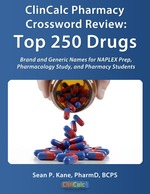
ClinCalc.com is officially in print! We are excited to announce the release of our first book, “ClinCalc Pharmacy Crossword Review: Top 250 Drugs: Brand and Generic Names for NAPLEX Prep, Pharmacology Study, and Pharmacy Students.”

If you have ever searched for a top 200 drugs list, top 250 drugs, or even top 300 drugs resource, you know that most options are flashcards, PDFs, or dense tables. This book takes those same high-yield medications and turns them into something active and memorable: pharmacy themed crossword puzzles.

Continue reading →

ClinCalc DrugStats: Most Commonly Prescribed Medications in 2021

ClinCalc has released the latest edition of the DrugStats database, featuring “The Top 200 Drugs of 2021”. DrugStats offers complementary access to estimated prescription drug utilization data for the United States. With this data set, users can discern patterns in prescribing habits and access an evidence-based, reputable “top 200 drugs” (or “top 300 drugs”) list based on data provided by the U.S. Government.

Where does the DrugStats data come from?

All medication utilization data comes from the annual Medical Expenditure Panel Survey (MEPS), a survey conducted by the Agency for Healthcare Research and Quality (AHRQ) via the United States government. This data is publicly available on the MEPS website for free. In order for the ClinCalc DrugStats database to implement the MEPS data, basic data sanitization and standardization measures are necessary to maintain an accurate and reliable data set. Read more about the data set by clicking here. Continue reading →

Add Brand/Generic Drug Names to Microsoft Office Word with the ClinCalc DrugSpell Dictionary File

By default, Microsoft Word and other Office products do not contain brand and generic medication names within the spelling dictionary.  For healthcare providers who conduct medical writing, publications, or PowerPoint lectures, this can lead to embarrassing spelling errors that are not captured by the spell check.

Spell checking drug names like atorvastatin (Lipitor®) can be frustrating. Avoid spelling errors (and the dreaded red squiggly lines) with the ClinCalc DrugSpell dictionary file. It’s free!

Introducing the ClinCalc DrugSpell Dictionary File

Continue reading →

Calculate a “Fragility Index” to see which clinical trials BARELY meet statistical significance

When evaluating a clinical trial, readers often jump to the P value of the primary endpoint to determine whether the results of a trial are “statistically significant” or not. Although the P value is truly a continuous variable, the scientific community has been conditioned to disregard all results with P values ≥ 0.05, but to fully endorse any trials with a “statistically significant” P value less than 0.05.

Putting the debate and controversy about P values aside for the moment, as a reader, would you be less impressed with a study that changed from being statistically significant to insignificant if one single patient changed from not having the primary endpoint to having the primary endpoint? Especially in an era with a blind reliance on P values, the knowledge of the “fragility” or “robustness” of a study’s P value is another useful data point for readers to critically understand and analyze the results of a clinical trial.

The Concept of the “Fragility Index” for Clinical Trials

Continue reading →

It’s Time to Say “Goodbye” to Vitamin D2 (ergocalciferol)

In the United States, vitamin D supplementation is primarily available as vitamin D2 (ergocalciferol) and vitamin D3 (cholecalciferol). Although these two have historically been considered interchangeable and equipotent, the current body of literature strongly supports the preference of Vitamin D3 (cholecalciferol) over D2 (ergocalciferol).

Vitamin D2 versus Vitamin D3

Vitamin D3 (cholecalciferol) is produced by the human body in response to sunlight and is also available through dietary sources, such as fish. In contrast, vitamin D2 (ergocalciferol) is not produced in the human body, but is created by exposing certain plant-derived materials to ultraviolet light.

Continue reading →

The Top 250 Drugs – Online Pharmacotherapy Video Course

ClinCalc.com has been a bit quiet over the past year.  Our Twitter account has been mute, email updates rare, and website updates sparse.

Why the radio silence?

We’ve been diligently working on an exciting new product for the past year.  Quite literally, HUNDREDS of hours have been poured into the conception, creation, and implementation of this amazing new product.  Given this massive undertaking, we’ve kept website and mobile app updates to a minimum in order to expedite our production schedule. Continue reading →